

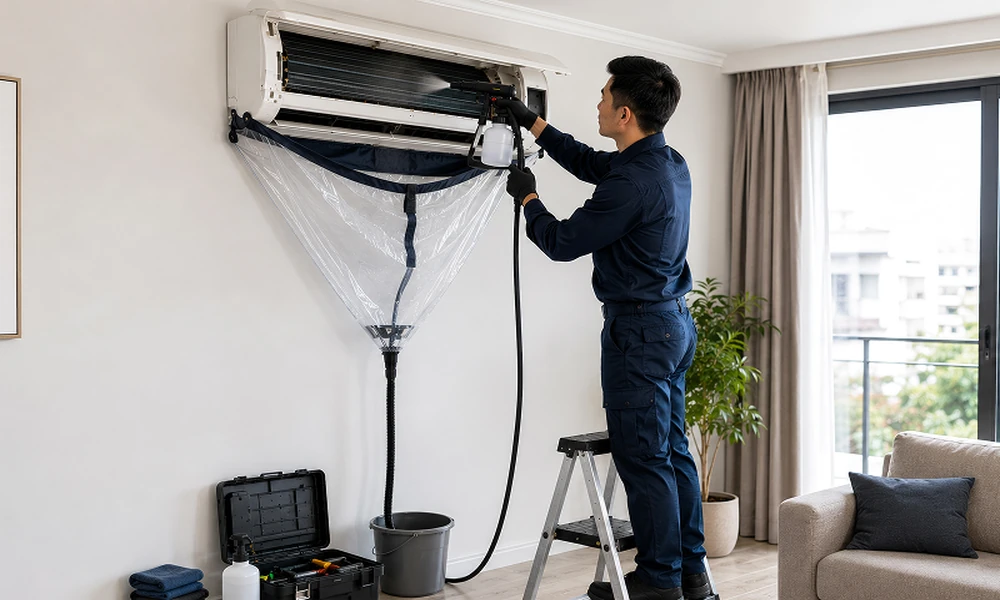
A household switching to steam cleaning after years of skipped servicing is, in effect, asking a maintenance tool to do a restoration job. Steam, using high-temperature vapour to loosen dirt and sanitise surfaces, genuinely excels at keeping an already reasonably clean unit that way. It was never designed to dissolve buildup that’s had years to harden and settle into a system’s internal components, a job that calls for something considerably more intensive.
Both methods are genuinely effective at what they’re actually built for. The mismatch happens when one gets asked to do the other’s job.
Why Steam Cleaning Has a Real Limit on What It Can Actually Remove
High-temperature steam works by loosening surface-level dirt and sanitising through heat, which makes it genuinely effective against light, recent buildup and the kind of routine grime that accumulates between regular servicing appointments. What it isn’t built for is heavy, long-settled buildup, the layered residue and hardened mould that develops over months or years of infrequent servicing. That kind of buildup needs a solution capable of actually dissolving it chemically, not just loosening it with heat and pressure.
This isn’t a flaw in steam cleaning as a method; it’s simply operating exactly within its intended scope. The mismatch only shows up when it’s asked to handle a job outside that scope.
Why This Limitation Actually Points Toward Chemical Cleaning Instead
A unit that’s gone a long stretch without proper servicing, or one showing genuine performance problems, weak cooling, water leaks, visible mould, generally needs a method built specifically to reach and dissolve that kind of entrenched buildup. Proper aircon chemical cleaning in Singapore involves dismantling key components and applying a targeted cleaning solution precisely for this reason, addressing buildup that steam alone genuinely can’t reach.
Signs a Unit Actually Needs the Deeper Chemical Approach
A handful of specific signals tend to indicate steam alone won’t be enough, and a chemical wash is the more appropriate option:
- It’s been over a year since the unit’s last proper servicing of any kind.
- Cooling performance has noticeably weakened compared to how the unit used to perform.
- Water leaking from the indoor unit, often a sign of a blocked drainage system.
- Visible mould or heavy grime on accessible parts of the unit.
Any one of these on its own is usually reason enough to skip straight to a chemical wash rather than starting with steam and hoping it’s sufficient.
Why Comparing the Two Methods Only Makes Sense Once Condition Is Factored In
Treating this purely as a preference between an eco-friendly option and a more intensive one misses the more important variable entirely: the unit’s actual current condition. A genuinely useful comparison of steam cleaning vs chemical wash starts with an honest look at maintenance history and current performance, not simply which method sounds gentler or more appealing on its own terms.
Why This Nuance Gets Lost in a Lot of General Advice
Plenty of general guidance frames the choice as steam being the modern, health-conscious option and chemical wash as the old-fashioned, harsher alternative, a framing that flattens a genuinely important distinction. Both methods are legitimate tools for different jobs, and recommending steam cleaning to someone with a genuinely neglected, heavily fouled unit isn’t actually the gentler choice; it’s simply the wrong tool applied to a problem it was never built to solve.
A quick, honest look at the unit’s actual maintenance history tends to answer this question more reliably than any general preference for one method over the other.
The right cleaning method depends far more on a unit’s actual history and current condition than on which option sounds more appealing in the abstract. A unit that’s been well maintained can often stay that way with steam alone. One that’s fallen behind usually needs the deeper intervention only a proper chemical wash can actually provide.
Matching the method to the unit’s actual condition, rather than to a general preference, is really the whole decision in the end.
Not sure which approach your unit actually needs? Contact Newway Air Conditioning for an honest assessment before booking.
