

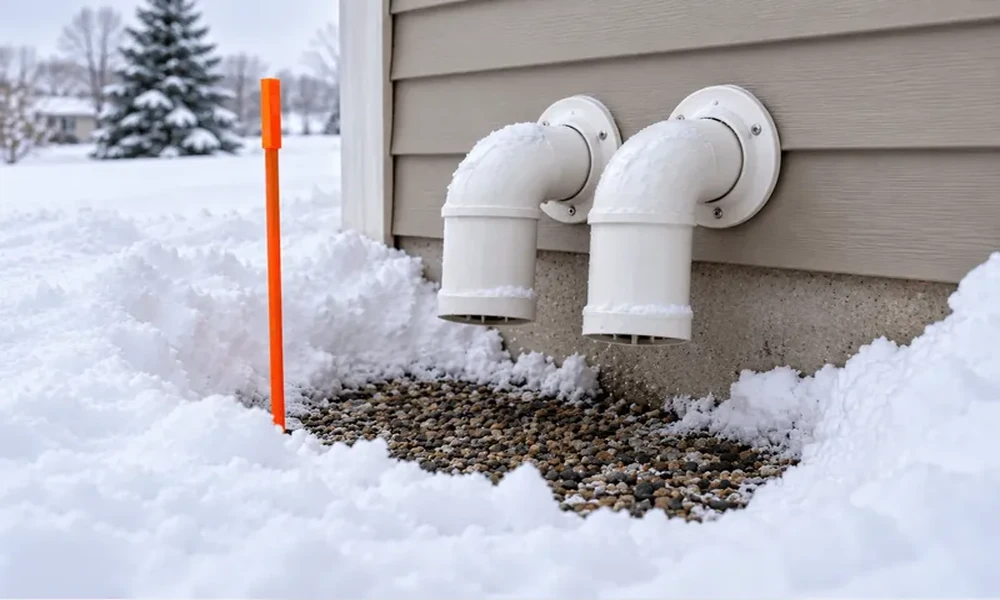
A big snowfall changes a house in ways you mostly notice from inside. The rooms feel muffled, the windows frost at the corners, and sometimes the furnace stops in the middle of the night. When that happens after a blizzard, the furnace usually isn’t broken. More often it can’t breathe.
Most furnaces installed in the last twenty years are high efficiency condensing models. They vent through two plastic pipes on a side wall instead of an old metal chimney. Those pipes often sit low, near where wind piles the snow. Technicians at shops like Advanced Heating and Air Conditioning get a wave of no-heat calls after almost every big storm. In many of those homes, the fix takes a gloved hand and five minutes, not a new part.
It helps to know why these furnaces are so sensitive to snow. Once you understand that, a scary cold-house morning becomes easier to handle.
Why Newer Furnaces Breathe Through the Wall
A condensing furnace pulls so much heat out of its exhaust that the gas leaving the house is only lukewarm. That’s why plain PVC pipe can carry it instead of a hot flue. The cooled exhaust also gives up water vapor, and that’s where the name comes from.
Most of these systems use two pipes. One brings in outdoor air to burn, and the other pushes exhaust out. A small fan called the inducer motor moves air through both. Before the burners light, a pressure switch checks that the air is moving the way it should. If that check fails, the furnace won’t fire. This safety feature is what turns a snowdrift into a cold house.
How a Buried Vent Shuts Everything Down
When snow blocks either pipe, the pressure switch senses the problem and stops the ignition. Most furnaces try a few more times, then lock themselves out for about an hour. A blinking light on the control board usually shows a pressure switch fault code. If the drift is still there when the furnace tries again, the whole cycle repeats.
Snow isn’t the only cause. Three winter problems account for most of these shutdowns.
Drifting Snow
Wind matters more than total snowfall. A vent on the side of the house facing the wind can stay clear while one on the sheltered side gets buried under a sloping drift. Snow sliding off the roof can do the same thing within seconds.
Frost Rings at the Exhaust
The exhaust carries warm, moist air. In bitter cold, that moisture can freeze on the pipe opening and build a ring of ice that slowly closes it off. This happens most often in long stretches of subzero weather, even when there’s no fresh snow.
Frozen Condensate Lines
A condensing furnace makes several gallons of water on a cold day. That water drains through a small tube to a floor drain or a pump. If part of the line runs through an unheated crawlspace, a garage, or outside, it can freeze. Water then backs up into the furnace, and a sensor shuts the burners off.
Clues That Point to the Vents First
Before you call for repair, a quick look outside and at the unit can tell you a lot. These signs suggest a blocked vent, not a failed part:
- The furnace stopped during or right after heavy snow or high wind
- You hear the inducer fan start, but the burners never light
- The furnace tries several times, then goes silent
- The control board blinks a pressure switch code
- Snow or ice covers the white pipes on the side of the house
- You hear gurgling, or see water near the furnace cabinet
If several of these match, check the pipes before anything else.
Clearing the Pipes Without Making Things Worse
First, set the thermostat to off. That stops the furnace from trying to light while you work. Then go outside and clear the snow from around both pipe openings by hand or with a soft broom. A shovel blade near PVC in deep cold is a bad idea, because cold plastic gets brittle and can crack from one hard knock.
For an ice ring, don’t chip at it with a hammer or screwdriver. Warm water poured slowly over the opening usually loosens it. A hair dryer on a long extension cord also works if you can safely keep the cord out of the snow. Clear a wide space around the pipes too, so the next gust doesn’t fill them back in.
Back inside, you may need to reset the furnace by switching its power off for about thirty seconds, then on again. Set the thermostat back to heat and listen. If it lights, you’ve found the problem. If it locks out again with clear vents, call a technician. A failed pressure switch, a weak inducer, or a cracked line inside the house needs professional diagnosis.
Small Changes That Prevent Repeat Lockouts
If your furnace shuts down every winter, the vent layout may be the real problem. Many installers put the pipes just above the minimum height the manufacturer allows, and that line can be well below a typical winter drift. Raising the openings with an approved extension kit often solves it for good.
Concentric vent kits are another option. They run intake and exhaust through one wider pipe, which shrinks the target that snow can block. Some homes do better with the vents moved to a sheltered wall, away from roof edges and wind-packed corners. Any of these changes has to follow the furnace maker’s spacing rules, because exhaust that drifts back into the intake causes its own trouble.
For condensate lines, the cleanest fix is a new route that stays inside heated space. Where that’s not possible, technicians can add a pipe heating cable rated for the job, or a condensate pump placed somewhere warm.
Why Carbon Monoxide Deserves a Thought Here
A blocked vent usually just stops the furnace, which is the safe outcome. Still, any venting problem calls for working carbon monoxide alarms. Exhaust can be pulled back into a house through a window, a door, or a poorly placed intake, especially when snow changes how air moves around the walls. The U.S. Consumer Product Safety Commission’s carbon monoxide information center recommends battery-backed alarms on every level of the home and outside sleeping areas.
The same guidance applies to the backup heat people reach for during outages and lockouts. Generators belong well away from the house, and so do grills and fuel heaters meant for outdoor use. If anyone gets a headache, feels dizzy, or gets confused while the furnace is acting up, get everyone outside first and figure out the furnace later.
Building a Habit Before the Next Storm
The homes that handle winter best usually have one simple routine. Someone walks out to the vent pipes after every big snow, just as they would check the driveway or mailbox. It takes less than a minute and turns most midnight lockouts into a non-event.
If you add a quick look at the condensate line before the first deep freeze and a fresh test of the carbon monoxide alarms, the furnace has a good chance of running all season. High efficiency furnaces are excellent at turning fuel into warmth, but they depend on clear air at the end of two small pipes, so keeping that space open is one of the easiest bits of home upkeep.
