

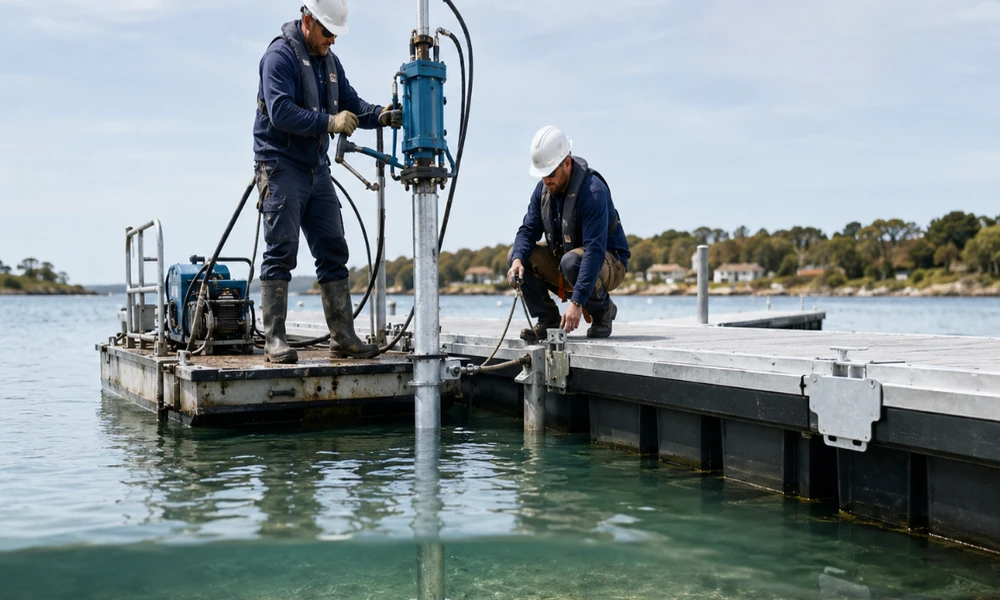
A floating dock needs enough freedom to move with water levels while staying securely positioned. Without a reliable anchoring system, wind, waves, currents, and passing boats might push the dock out of alignment.
Several anchoring methods are available. One option is the helical anchor, which transfers dock movement into the soil below the water. Its screw-like design helps create a strong holding point without requiring a large concrete block on the bottom.
What Is a Helical Anchor?
A helical anchor consists of a steel shaft with one or more circular plates welded near its lower end. These plates look similar to the threads of a large screw.
During installation, the anchor rotates into the lakebed, riverbed, or seabed. The helical plates move through the soil and provide resistance once they reach the required depth.
A chain, cable, rod, or flexible connection links the installed anchor to the floating dock. This connection holds the dock in place while allowing controlled vertical movement.
How Do Helical Anchors Improve Stability?
A floating dock receives pressure from several directions. Wind might push it toward shore, while waves and currents pull it sideways. Boats tied to the dock add even more movement.
Helical anchors resist these horizontal and upward forces by transferring them into the surrounding soil. Multiple anchors are often placed around the dock to provide support from different directions.
The layout matters. Anchors placed at proper angles help reduce side-to-side movement and prevent the dock from drifting. The number of anchors depends on the dock’s size, expected loads, water conditions, and bottom material.
Why Does the Bottom Material Matter?
Helical anchors rely on the strength of the soil surrounding their plates. Sand, clay, silt, and mixed soils behave differently under pressure.
Firm soil often provides stronger support than loose sediment. Very soft mud might require a longer shaft so the anchor reaches a more stable layer. Rocky bottoms might make installation difficult if the plates cannot move around or through obstructions.
A site evaluation helps determine the appropriate shaft length, plate size, and installation depth. Guessing based on water depth alone might result in an anchor that looks secure but lacks enough holding strength.
How Are Helical Anchors Installed?
Installation usually involves hydraulic or mechanical equipment that rotates the anchor into the bottom. Extension shafts are added when greater depth is necessary.
Installers monitor the amount of rotational force, known as torque, required to advance the anchor. Torque readings help indicate how much resistance the soil provides. These readings also help determine whether the anchor has reached a suitable bearing layer.
The anchor should enter at the planned angle and location. Poor alignment might reduce its ability to resist the expected direction of movement.
After installation, the connection system is adjusted to hold the dock in position without preventing normal movement.
What Are the Main Advantages?
Helical anchors have a relatively small footprint on the bottom compared with large concrete weights. They also do not require extensive excavation.
Their main advantages include:
- Strong resistance in suitable soil
- Installation with limited bottom disturbance
- Use in shallow or deeper water
- Adjustable shaft lengths
- Measurable installation torque
- Removal or relocation in some applications
- Compatibility with several dock connection systems
They work well in many locations, but they are not the right choice for every waterfront.
What Should Owners Inspect?
The anchor itself is underwater, so its condition is not always easy to see. Owners should inspect all accessible chains, cables, shackles, rods, and dock brackets.
Look for corrosion, worn links, loose fasteners, bent hardware, and damaged protective coatings. The dock should remain in its normal position without excessive sideways movement.
Uneven tension is another warning sign. One connection carrying most of the load might wear faster and place stress on the dock frame.
Inspections are especially important after storms, flooding, unusually low water, or impacts from boats and floating debris.
Why Does Professional Planning Matter?
Anchor capacity depends on soil strength, dock size, water depth, environmental exposure, and expected forces. Local permit requirements and environmental restrictions also influence installation.
A properly planned helical anchor system balances stability with movement. It holds the floating dock in position while allowing it to rise, fall, and respond safely to normal water conditions. With correct installation and routine inspection, helical anchors provide a practical foundation for long-term floating dock stability.
This post was written by a professional at Supreme Marine Floating Docks. Supreme Marine Floating Docks is dedicated to providing top-quality floating dock Ft Lauderdale and marine accessories that combine durability, innovation, and superior performance. While we are a new brand, our team brings over 50 years of combined industry experience, making us a trusted name in the marine world. We are passionate about designing and delivering products that meet the highest standards, ensuring reliability and longevity in all marine environments. Whether for residential, commercial, or recreational use, our docks are crafted with precision and care, setting a new benchmark in the industry. At Supreme Marine, we don’t just build docks-we create lasting solutions.
